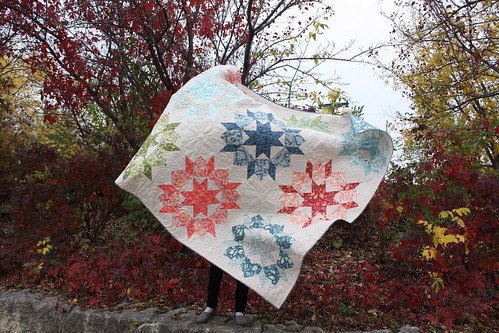
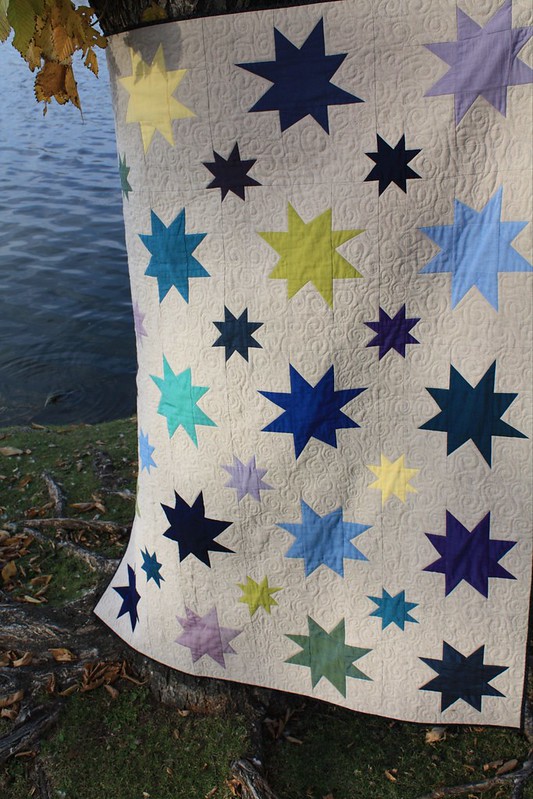
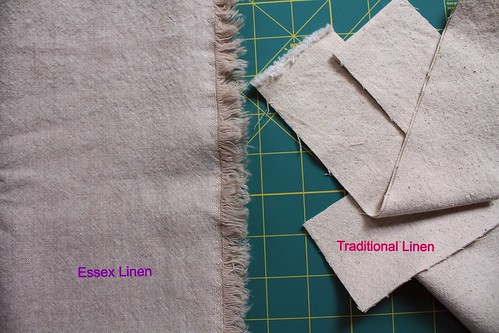
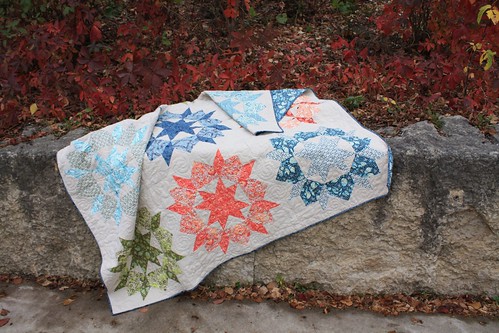
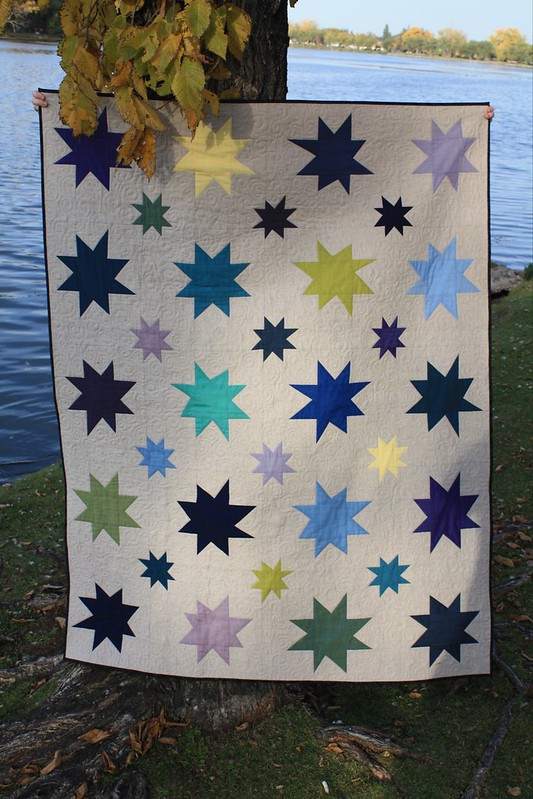
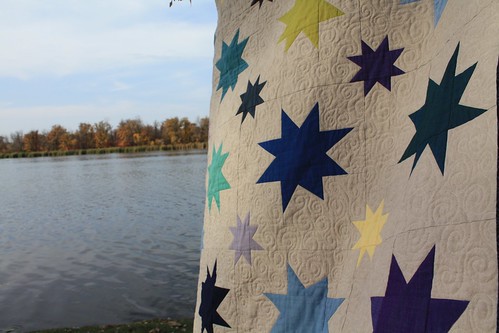
After recently finishing two quilts using backgrounds made from both traditional linen and an Essex yarn dyed linen, I thought it might be valuable to summarize my findings while they're still fresh in my mind. Here are the two quilts I'm going to reference:
Making these quilts in parallel was a fantastic way to look at the pros and cons of both textile, so I can better understand how and when to use them again in the future.
While there are a number of differences between the two textiles, the main thing that stood out to me was weave density. I quilt almost exclusively with high quality quilting cottons (the exception being some
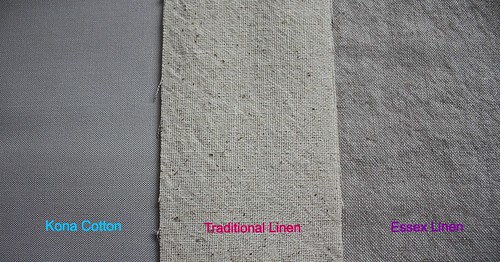
African wax prints) so I am used to working with tightly woven cotton that doesn't stretch much. For comparison, here is a close up of the two linens next to another commonly used quilter's background fabric, Kona cotton.
Even if you aren't familiar with linens, I'm sure you can see the difference in the various thread weaves. The Kona cotton on the left has the tightest weave, followed by the Essex linen in the right, and lastly by the traditional linen. It also seems as though the traditional linen has a lower thread count. In places you can see between the threads (I should have taken a photo up against a window to demonstrate this better - sorry!).
Essex Linen:
It's pretty clear by the comparison photo above that the Essex linen also has a lower thread count than the Kona cotton but the weave is relatively tight and very even. I found that when working with the Essex it acted surprisingly similar to the quilting cottons I am used to. Here are a few of my findings after quilting with it:
Notes about Essex Linen:
- It's quite a bit heavier than a standard high quality quilters cotton, and softer too;
- Its yarn dyed nature adds a lot of texture up close. More so than a standard cotton, but less so than a traditional linen;
- It holds its shape well when cutting and piecing but it does stretch to a certain degree so i did try to be a bit more careful than usual;
- I didn't need to starch or go overboard basting;
- It gives a nice drape to quilt tops;
- It doesn't like to iron out as easily as traditional quilters cotton. If you love a good crinkly quilt then this might suit you splendidly;
It is also worth noting that I prewashed my fabric when making the Wonky Star Quilt because I was using three different types of textiles, including Essex linen, Oakshott cotton and Shot cotton, all of which differ in their own way from a traditional quilters cotton. Because of this, I can't say how much it shrank.
My final thoughts on Essex Linen: I am absolutely crazy about Essex linen and I will without a doubt use this again in the future. It's soft, multi-dimensional, and easy to work with, plus the extra weight it offers will be perfect for Canadian winters. This linen will also be perfect for bags, sturdy pillow backings and any other home sewing items I add to my to-sew list.
Traditional Linen:
My Salt Water Quilt was the first time I have ever worked with linen, or for that matter, a loose weave textile. While it was trickier to deal with than using a standard quilting cotton and took quite a bit more organization, I am very happy with the result. To save you some of the heart ache that I endured, I have created a simple cheat sheet of tips for using traditional linen successfully. I know I will be referencing this again myself in the future.
Tips for Quilting with Traditional Linen:
- Prewash! I cannot stress this enough. I NEVER prewash my quilting cottons but I will ALWAYS prewash linen (I learned this the hard way);
- After you prewash, toss it in the dryer on high heat and shrink it on purpose before you cut (it shrinks like crazy!);
- Spray starch is your friend as traditional linen tends to stretch easily. Using a starch will keep your fibers firm when piecing;
- Measure your pieces frequently when piecing to make sure they haven't been stretched;
- Piece linen blocks using straight lines. Curved pieces are likely to stretch and skew so be wary of this if your pattern calls for lots of curves;
- Be cognizant of your movement during ironing. Be sure to press seams flat using an up-down motion. If you slide your iron across seams from side-to-side, your linen may stretch;
- Baste, baste, baste. Spray baste with 505 and then use boat loads of pins to help reduce your top from stretching during quilting; and
- Use a batting with Scrim to give structure when quilting. My long armed quilter used this when she quilted my Salt Water Swoon Quilt.
You probably just read that list and thought to yourself, "dang girl, why would I ever want to quilt with linen?!".
So this is my response: Is working with traditional linen tedious? Yes, I won't deny that fact. But in all honesty I can say that without a doubt sometimes it is absolutely worth it - here's why:
Reasons to Quilt with Traditional Linen:
- It's soft. Like seriously down right snuggly soft;
- It adds depth in your quilt that your run of the mill solid just can't. Linens are often composed of multiple colours, especially when they're called 'natural'. When making my Salt Water Swoon Quilt, I chose traditional linen because it looked just like sand. A solid background couldn't offer me that image;
- It gives texture. While quilting cottons are smooth to the touch, traditional linen has lumps, bumps and fuzzies. This can be unusual for a quilter but it's worth embracing;
- It drapes. Using linen as a background on a queen sized quilt will help give drape to your quilt, even if the backing is cotton. My Salt Water Swoon Quilt is great proof of that.
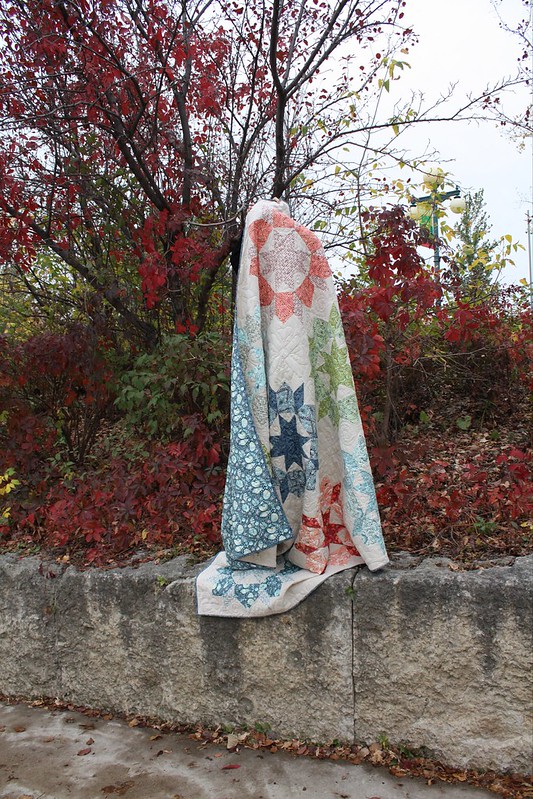
My final thoughts on traditional linen: While I experienced a number of setbacks when working with linen on my Salt Water Quilt, I learned a ton and for that I am grateful. This quilt not only has lovely drape, but it is also the softest and most snuggable quilt that I have ever made. I would like to say that I will definitely quilt with traditional linen again but due to it's delicate nature, I want to see how it holds up after a few machine washes. If it withstands over time, I will definitely consider using it again on more bed quilts. As for lap quilts, baby quilts, bags, or other items that receive more abrasive wear and tear, I may gravitate towards cotton or Essex linen for their sturdier weave.
I hope this post offers a few perspectives on when, where and how linen can be incorporated into your next project. Don't be afraid to expand out of the quilters cotton comfort zone and test out something new!